
Hello Friends! Are you looking to invest in the stock market, or have you already invested? Would you like to know the predictions regarding the potential fluctuations in your shares? If so, you have landed on exactly the right page. On this page, you will find information regarding Maruti Share Price today NSE, Maruti share price chart, Maruti share price 1990, Maruti share price option chain, Maruti share price screener, Maruti share price 2030, Maruti share price target tomorrow, and much more. Furthermore, this page provides details on Maruti‘s share price targets 2026, 2027, 2028, 2029, 2030, 2040, and beyond.
Maruti Company Information
Maruti Suzuki India Limited is the Indian subsidiary of the Japanese automaker Suzuki Motor Corporation. It is India’s largest automobile manufacturer, specializing in the production of small cars. The company was established by the Government of India.
| Industry | Automotive |
| Founded | 24 February 1981; 45 years ago |
| Headquarters | New Delhi, India |
| Key people | R. C. Bhargava (chairman) Hisashi Takeuchi (Managing Director & CEO) Kenichi Ayukawa (Executive Vice Chairman) Shasank Srivastava (Executive Director) |
| Products | Automobiles Commercial vehicles Automotive parts |
Maruti Share Price Target Overview
- Current Price – 12,631.00
- Open – 12,389.00
- High – 12,673.00
- Low – 12,239.00
- Mkt cap – 3.96LCr
- P/E ratio – 26.51
- 52-wk high – 17,370.00
- Dividend – 1.07%
- Qtrly div amt – 33.68
- 52-wk low – 11,059.45
Maruti Share Price Chart
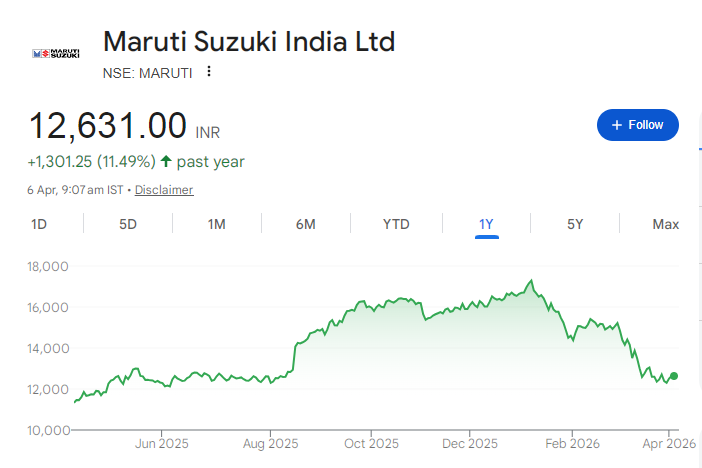
Maruti Share Price Target Tomorrow
| Maruti Share Price Target Years | Maruti Share Price Target |
| 2026 | ₹17,400 |
| 2027 | ₹20,210 |
| 2028 | ₹22,650 |
| 2029 | ₹24,865 |
| 2030 | ₹27157 |
Maruti Share Price Target 2026
The target for Maruti’s share price in 2026 is projected to range between ₹17,300 and ₹17,400. As of the start of April 2026, Maruti’s share price stood at ₹12,631.00. Compared to the previous year, Maruti’s share price has witnessed an increase this year.
Maruti Share Price Target 2027
The target for Maruti’s share price in 2027 is projected to range between ₹20,100 and ₹20,210. On 6 April 2026, Maruti Share price NSE is 12,631.00 INR. Compared to last year, no significant difference has been observed in the share price of Maruti. The share price has increased by approximately 2000-3000 rupees.
Maruti Share Price Target 2030
The target for Maruti’s share price in 2030 is projected to range between ₹27,000 and ₹27,157. Over the past several years, the company has generated substantial profits, and investors, too, have earned handsome returns proportionate to their shareholdings. We remain optimistic that the company will continue to generate profits in the future, thereby ensuring continued returns for its investors.
Risks and Challenges Of Maruti Share Price
Here are 8 key factors affecting the growth of Maruti share price:
1. Dependence on Domestic Market – Maruti earns most of its revenue from India. If Indian car demand slows down (due to inflation, low income growth, or high interest rates), sales drop — and this directly affects the share price.
2. Increasing Competition – Competition is rising from companies like Tata Motors, Hyundai, and even new EV players. If Maruti fails to keep up with new designs, tech, or pricing, it can lose market share — which investors don’t like.
3. Weak Position in Electric Vehicles (EVs) – The future is clearly EVs, but Maruti entered this space late. If it cannot catch up quickly, it may lose long-term growth potential, impacting investor confidence and stock valuation.
4. Raw Material Price Volatility – Steel, aluminum, and semiconductor prices directly affect production cost. If costs rise and Maruti can’t pass them on to customers, profit margins shrink — hurting the share price.
5. Currency Fluctuations (Yen vs Rupee) – Maruti’s parent company is Suzuki Motor Corporation. If the Japanese Yen strengthens against the Rupee, costs increase, which can reduce profits.
6. Regulatory and Emission Norms – Strict government rules (BS6, safety norms, EV push) increase costs. Frequent changes force companies to invest heavily, which can impact margins and stock performance.
7. Slow Premium Segment Growth – Maruti is strong in budget cars but weaker in premium segments. Higher growth and profits often come from premium vehicles — so this gap can limit valuation growth.
8. Rural Demand Uncertainty – A big portion of Maruti sales comes from rural India. If monsoon is weak or rural income falls, car demand drops — directly affecting revenue and share price.
Read Also:- Nestle India Share Price Target Tomorrow 2026, 2027 to 2030 – Current Chart, Market Overview
Key Factors Affecting Growth Maruti Share Price
Here are 8 key factors affecting the growth of Maruti share price:
1. Strong Brand Value & Market Leadership – Maruti is India’s largest car manufacturer with a trusted brand. This strong reputation helps maintain high sales volume, which supports steady revenue growth and keeps investor confidence strong.
2. Expansion in Electric Vehicle (EV) Segment – The future of automobiles is electric. If Maruti successfully launches competitive EVs and scales production, it can unlock new growth — which can push the share price higher.
3. Rural Market Growth – Maruti has a deep reach in rural India. If rural income rises (good monsoon, government support), car demand increases — directly boosting sales and share price.
4. New Product Launches & Innovation – Regular launch of new models with better features attracts customers. If Maruti continues to innovate (SUVs, hybrids, EVs), it can capture more market share and drive stock growth.
5. Partnership with Suzuki Motor Corporation – Strong backing from its parent company brings advanced technology and global expertise. This helps Maruti improve efficiency, introduce new models, and stay competitive.
6. Export Growth Potential – Maruti is increasing focus on exports. Higher exports reduce dependency on India alone and open global revenue streams — a positive sign for long-term stock growth.
7. Cost Control & Profit Margins – Efficient cost management (raw materials, supply chain) improves profit margins. Higher profits = better earnings per share = positive impact on share price.
8. Government Policies & Auto Sector Growth – Supportive policies like EV incentives, lower taxes, or infrastructure growth can boost auto demand. A growing automobile industry directly benefits Maruti’s performance and stock valuation.
Maruti Shareholding Pattern
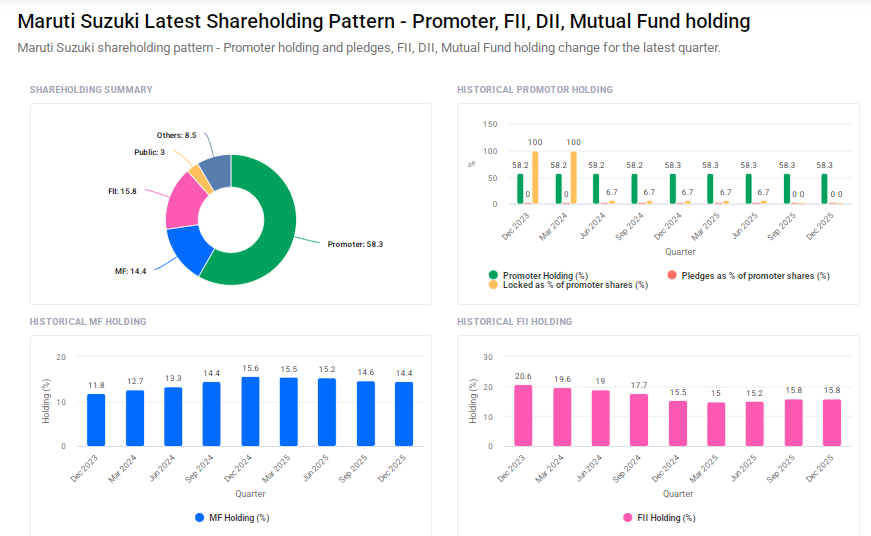
| Promoter | 58.3% |
| FII | 15.8% |
| DII | 22.9% |
| Public | 3.0% |
Income Statement Of Maruti
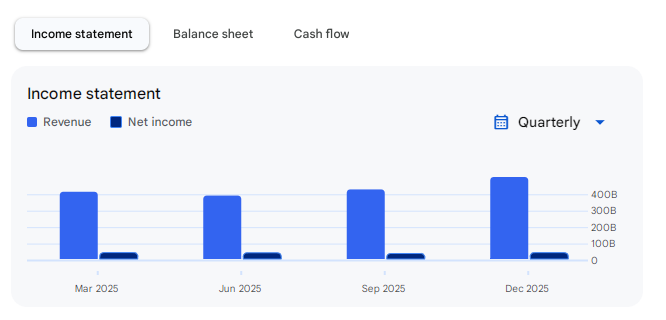
|
All values in INR
|
Mar 2025
|
Jun 2025
|
Sep 2025
|
Dec 2025
|
|---|---|---|---|---|
|
Revenue
|
409.20B
|
386.05B
|
423.44B
|
499.04B
|
|
Cost of goods sold
|
307.09B
|
272.73B
|
303.97B
|
362.20B
|
|
Cost of revenue
|
307.09B
|
272.73B
|
303.97B
|
362.20B
|
|
Research and development expenses
|
–
|
–
|
–
|
–
|
|
Total research and development expenses
|
–
|
–
|
–
|
–
|
|
Selling, general, and admin expenses
|
35.91B
|
20.48B
|
20.52B
|
27.01B
|
|
Operating expense
|
67.54B
|
82.66B
|
85.65B
|
98.46B
|
|
Total operating expenses
|
374.63B
|
355.39B
|
389.61B
|
460.66B
|
|
Operating income
|
34.57B
|
30.67B
|
33.83B
|
38.39B
|
|
Other non operating income
|
-35.18B
|
18.88B
|
9.46B
|
10.55B
|
|
EBT including unusual items
|
49.18B
|
49.44B
|
43.39B
|
49.17B
|
|
EBT excluding unusual items
|
4.56B
|
49.44B
|
43.39B
|
49.17B
|
|
Income tax expense
|
10.07B
|
11.51B
|
9.90B
|
10.38B
|
|
Effective tax rate
|
20.47%
|
23.29%
|
22.82%
|
21.11%
|
|
Other operating expenses
|
17.01B
|
46.62B
|
48.09B
|
54.11B
|
|
Net income
|
39.11B
|
37.92B
|
33.49B
|
38.79B
|
|
Net profit margin
|
9.56%
|
9.82%
|
7.91%
|
7.77%
|
|
Earnings per share
|
118.04
|
118.06
|
104.74
|
120.67
|
|
Interest and investment income
|
4.42B
|
–
|
–
|
–
|
|
Interest expense
|
-476.00M
|
-468.00M
|
-572.00M
|
-617.00M
|
|
Net interest expenses
|
3.95B
|
-468.00M
|
-572.00M
|
-617.00M
|
|
Depreciation and amortization charges
|
14.62B
|
15.56B
|
17.03B
|
17.35B
|
|
EBITDA
|
48.39B
|
44.69B
|
50.13B
|
52.21B
|
|
Gain or loss from assets sale
|
–
|
–
|
–
|
–
|

Hi, I’m Ronak, a news writer covering the latest updates in automobiles, education, smartphones, and trending topics. I focus on delivering simple, clear, and timely news to keep readers informed about what’s happening around the world.