
Hello Friends! Are you looking to invest in the stock market, or have you already invested? Would you like to know the predictions regarding the potential fluctuations in your shares? If so, you have landed on exactly the right page. On this page, you will find information regarding Bajaj Finance share price target 2030, Bajaj Finance share price in 1992, Bajaj Finance share price history, Bajaj Finance share price target after 10 years, Bajaj Finance share price screener, Bajaj Finserv share price NSE, Bajaj Finance share price chart, and much more. Furthermore, this page provides details on Bajaj Finance‘s share price targets 2026, 2027, 2028, 2029, 2030, 2040, and beyond.
Bajaj Finance Company Information
Bajaj Finance Limited (BFL) is an Indian deposit-taking non-banking financial company. As of September 2025, the company has 110.64 million customers. The company has assets under management worth ₹462,250 crore (US$55 billion). As of 2025, the company has 64,092 employees.
| Industry | Financial services |
| Headquarters | Pune, India |
| Founded | 25 March 1987; 39 years ago |
| Founder | Rahul Bajaj |
| Products | Lending, fixed deposits, mutual funds |
| Key people | Sanjiv Bajaj Rajeev Jain |
Bajaj Finance Share Price Target Overview
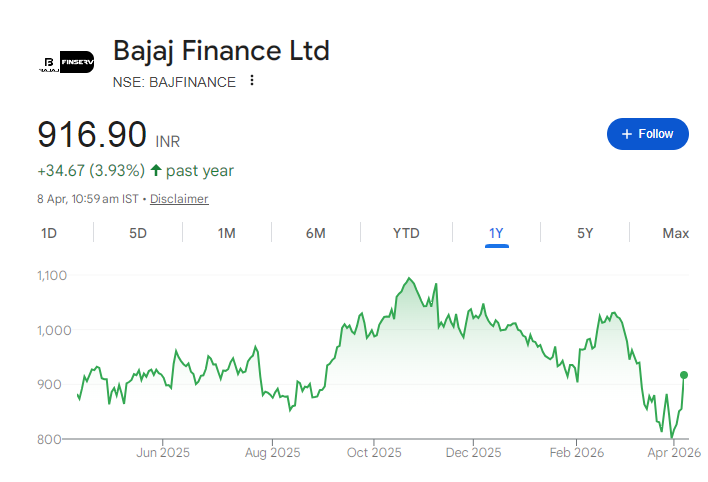
- Current Price – 916.55
- Open – 890.00
- High – 918.60
- Low – 881.00
- Mkt cap – 5.70LCr
- P/E ratio – 31.65
- 52-wk high – 1,102.50
- 52-wk low – 787.90
- Dividend – 0.48%
- Qtrly div amt – 1.10
Bajaj Finance Share Price Chart
Bajaj Finance Share Price Target Tomorrow
| Bajaj Finance Share Price Target Years | Bajaj Finance Share Price Target |
| 2026 | ₹1110 |
| 2027 | ₹1230 |
| 2028 | ₹1350 |
| 2029 | ₹1470 |
| 2030 | ₹1600 |
Bajaj Finance Share Price Target 2026
The target for Bajaj Finance’s share price in 2026 is projected to range between ₹1100 and ₹1110. As of the start of April 2026, Bajaj Finance’s share price stood at ₹916.55. Compared to the previous year, Bajaj Finance’s share price has witnessed an increase this year.
Bajaj Finance Share Price Target 2027
The target for Bajaj Finance’s share price in 2027 is projected to range between ₹1210 and ₹1230. On 8 April 2026, Bajaj Finance Share price NSE is 916.55 INR. Compared to last year, no significant difference has been observed in the share price of Bajaj Finance. The share price has increased by approximately 100-150 rupees.
Bajaj Finance Share Price Target 2030
The target for Bajaj Finance’s share price in 2030 is projected to range between ₹1570 and ₹1600. Over the past several years, the company has generated substantial profits, and investors, too, have earned handsome returns proportionate to their shareholdings. We remain optimistic that the company will continue to generate profits in the future, thereby ensuring continued returns for its investors.
Risks and Challenges Of Bajaj Finance Share Price
Here are 7 key factors affecting the growth of Bajaj Finance share price:
1. Rising Interest Rates –
Bajaj Finance borrows money to lend.
If interest rates increase:
- Borrowing cost rises
- Margins get squeezed
This can negatively impact profitability and share price.
2. Increase in NPAs (Bad Loans) – If customers fail to repay loans, NPAs (Non-Performing Assets) increase. Higher NPAs reduce profits and create negative sentiment among investors.
3. Economic Slowdown –
During economic slowdown:
- Loan demand decreases
- Default risk increases
This directly impacts business growth and stock performance.
4. High Valuation Risk – Bajaj Finance often trades at premium valuation compared to peers. If growth slows even slightly, the stock may see sharp correction.
5. Regulatory Changes (RBI Rules) – NBFCs like Bajaj Finance are regulated by the RBI. Any strict rules on lending, capital requirements, or digital lending can affect growth.
6. Intense Competition –
Competition from:
- Banks
- Other NBFCs
- Fintech companies
This can lead to pricing pressure and lower margins.
7. Dependence on Consumer Lending – A large part of Bajaj Finance’s business is retail/consumer loans. If consumer spending weakens, loan growth slows → impacts earnings.
Read Also:- BEL Share Price Target Tomorrow From 2026 to 2030 – Market Overview, Financials
Key Factors Affecting Growth Bajaj Finance Share Price
Here are 7 key factors affecting the growth of Bajaj Finance share price:
1. Strong Loan Growth – Bajaj Finance grows when it gives more loans across segments like consumer, personal, and business loans. Higher loan disbursement = higher interest income → boosts share price.
2. Low NPAs (Healthy Asset Quality) – Maintaining low bad loans is very important. Lower NPAs = better profitability and strong investor confidence.
3. Digital Lending & Technology Adoption – Bajaj Finance is investing heavily in digital platforms and apps. Faster loan approvals and better customer experience help scale the business quickly.
4. Interest Rate Environment –
- Lower interest rates = cheaper borrowing
- Better margins = higher profits
This positively impacts earnings and share price growth.
5. Customer Base Expansion – Growing its customer base (millions of users) increases cross-selling opportunities. More customers = more products sold = higher revenue.
6. Diversified Loan Portfolio –
Bajaj Finance offers loans in multiple categories:
- Consumer durable
- Personal loans
- SME loans
Diversification reduces risk and supports stable growth.
7. Strong Brand & Parent Support (Bajaj Group) – Being part of the Bajaj Group builds trust among customers and investors. This helps in consistent growth and long-term stock demand.
Bajaj Finance Shareholding Pattern
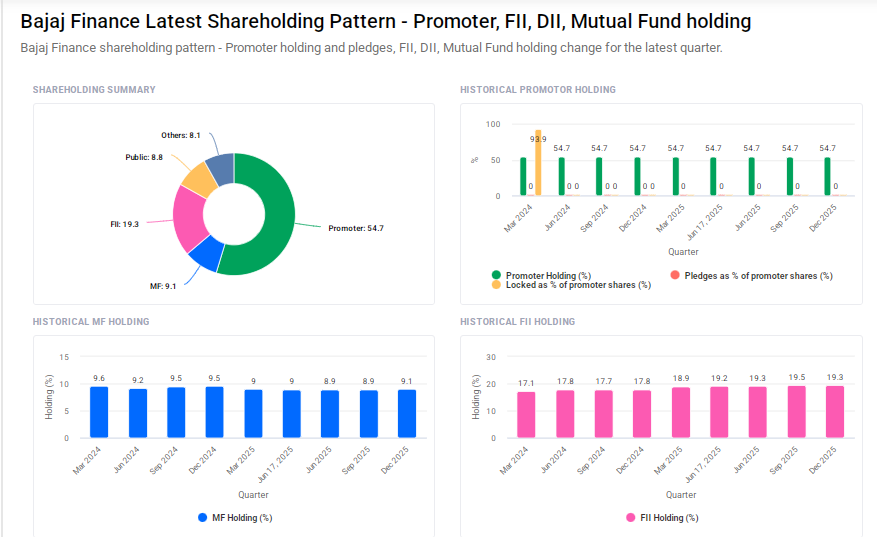
| Promoter | 54.7% |
| FII | 19.3% |
| DII | 17.1% |
| Public | 8.9% |
Income Statement Of Bajaj Finance
|
All values in INR
|
Mar 2025
|
Jun 2025
|
Sep 2025
|
Dec 2025
|
|---|---|---|---|---|
|
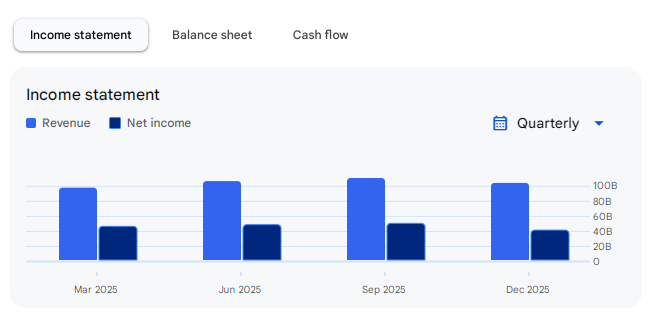
Revenue
|
96.19B
|
104.90B
|
109.01B
|
102.50B
|
|
Cost of goods sold
|
7.29B
|
7.67B
|
8.36B
|
10.09B
|
|
Cost of revenue
|
7.29B
|
7.67B
|
8.36B
|
10.09B
|
|
Research and development expenses
|
–
|
–
|
–
|
–
|
|
Total research and development expenses
|
–
|
–
|
–
|
–
|
|
Selling, general, and admin expenses
|
24.25B
|
21.03B
|
21.54B
|
22.50B
|
|
Operating expense
|
32.42B
|
33.56B
|
34.60B
|
35.47B
|
|
Total operating expenses
|
39.71B
|
41.23B
|
42.96B
|
45.56B
|
|
Operating income
|
56.48B
|
63.67B
|
66.05B
|
56.93B
|
|
Other non operating income
|
259.30M
|
–
|
–
|
6.90M
|
|
EBT including unusual items
|
56.47B
|
63.68B
|
66.08B
|
54.31B
|
|
EBT excluding unusual items
|
56.83B
|
63.68B
|
66.08B
|
56.96B
|
|
Income tax expense
|
11.02B
|
16.02B
|
16.60B
|
13.65B
|
|
Effective tax rate
|
19.51%
|
25.16%
|
25.13%
|
25.13%
|
|
Other operating expenses
|
5.65B
|
10.01B
|
10.48B
|
10.53B
|
|
Net income
|
44.80B
|
47.00B
|
48.75B
|
39.78B
|
|
Net profit margin
|
46.57%
|
44.80%
|
44.73%
|
38.81%
|
|
Earnings per share
|
7.22
|
6.64
|
7.83
|
8.79
|
|
Interest and investment income
|
–
|
–
|
–
|
–
|
|
Interest expense
|
–
|
–
|
–
|
–
|
|
Net interest expenses
|
–
|
–
|
–
|
–
|
|
Depreciation and amortization charges
|
2.52B
|
2.51B
|
2.58B
|
2.44B
|
|
EBITDA
|
–
|
–
|
–
|
–
|
|
Gain or loss from assets sale
|
–
|
–
|
–
|
–
|

Hi, I’m Ronak, a news writer covering the latest updates in automobiles, education, smartphones, and trending topics. I focus on delivering simple, clear, and timely news to keep readers informed about what’s happening around the world.