
Hello Friends! Are you looking to invest in the stock market, or have you already invested? Would you like to know the predictions regarding the potential fluctuations in your shares? If so, you have landed on exactly the right page. On this page, you will find information regarding Tata Motors share price demerger, Tata Motors share price screener, Tata Motors CV share price NSE, Tata Motors share price 2030, Tata Motors share price bike, Tata Motors Commercial Vehicles share price, Tata Motors share price chart, and much more. Furthermore, this page provides details on Tata Motors‘s share price targets 2026, 2027, 2028, 2029, 2030, 2040, and beyond.
Tata Motors Company Information
Tata Motors Limited also recognized as TML Commercial Vehicles Ltd, or Tata Motors Commercial Vehicles Limited. It is an Indian multinational commercial vehicle manufacturer company. It is a part of the Tata group. This company manufactures trucks, vans, and buses. As of 2025, the company have 86,259 employees.
| Industry | Automotive |
| Headquarters | Mumbai, Maharashtra, India |
| Founded | 23 June 2024; 21 months ago |
| Founders | JRD Tata |
| Products | Buses Vans Trucks Automotive parts |
Tata Motors Share Price Target Overview
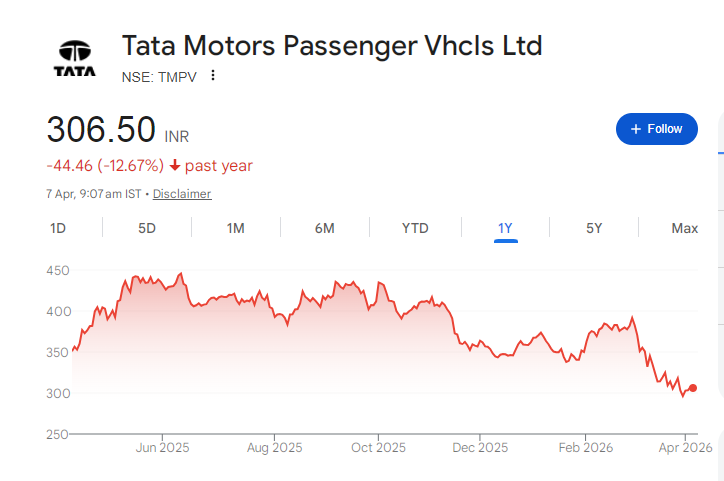
- Current Price – 306.50
- Open – 303.30
- High – 308.10
- Low – 299.85
- Mkt cap – 1.12LCr
- P/E ratio – N/A
- 52-wk high – 419.00
- Dividend – N/A
- Qtrly div amt – N/A
- 52-wk low – 294.30
Tata Motors Share Price Chart
Tata Motors Share Price Target Tomorrow
| Tata Motors Share Price Target Years | Tata Motors Share Price Target |
| 2026 | ₹450 |
| 2027 | ₹500 |
| 2028 | ₹600 |
| 2029 | ₹700 |
| 2030 | ₹800 |
Tata Motors Share Price Target 2026
The target for Tata Motors’s share price in 2026 is projected to range between ₹400 and ₹450. As of the start of April 2026, Tata Motors’s share price stood at ₹306.50. Compared to the previous year, Tata Motors’s share price has witnessed an increase this year.
Tata Motors Share Price Target 2027
The target for Tata Motors’s share price in 2027 is projected to range between ₹450 and ₹500. On 7 April 2026, Tata Motors Share price NSE is 306.50 INR. Compared to last year, no significant difference has been observed in the share price of Tata Motors. The share price has increased by approximately 50 rupees.
Tata Motors Share Price Target 2030
The target for Tata Motors’s share price in 2030 is projected to range between ₹750 and ₹800. Over the past several years, the company has generated substantial profits, and investors, too, have earned handsome returns proportionate to their shareholdings. We remain optimistic that the company will continue to generate profits in the future, thereby ensuring continued returns for its investors.
Risks and Challenges Of Tata Motors Share Price
Here are 10 key factors affecting the growth of Tata Motors share price:
1. High Dependence on Jaguar Land Rover (JLR) – A large portion of Tata Motors’ profits comes from JLR. If global luxury car demand slows (especially in China, US, Europe), overall earnings can fall — impacting share price.
2. Cyclical Nature of Auto Industry – The automobile sector is highly cyclical. During economic slowdown, people delay buying vehicles, which reduces sales and puts pressure on the stock.
3. Global Economic Slowdown Risk – Tata Motors has strong global exposure through JLR. Any slowdown in key markets like Europe or China can directly affect revenue and investor sentiment.
4. Rising Raw Material Costs – Costs of steel, aluminum, and other inputs fluctuate frequently. If costs rise and cannot be fully passed to customers, profit margins shrink.
5. High Debt Levels (Historical Concern) – Although improving, Tata Motors has carried high debt in the past (mainly due to JLR). High debt increases financial risk and interest burden, which can impact profitability.
6. Transition to Electric Vehicles (EV Risk) – The company is investing heavily in EVs. If EV adoption is slower than expected or investments don’t generate returns quickly, it can impact financial performance.
7. Intense Competition
Competition is strong in both segments:
- Domestic: Maruti, Mahindra, Hyundai
- Global (JLR): BMW, Mercedes, Audi
More competition means pricing pressure and slower growth.
8. Currency Fluctuation Risk – Tata Motors earns globally but reports in INR. Currency volatility (especially GBP, USD, Yuan) can impact profits and earnings stability.
9. Regulatory & Emission Norms – Strict emission rules (BS6, Euro norms) require heavy investment. Compliance increases costs and can affect margins.
10. Execution Risk in Turnaround Strategy – Tata Motors has been improving performance, especially JLR turnaround. If execution fails (delays, weak demand, strategy issues), investor confidence can drop quickly.
Read Also:- Ather Share Price Target Tomorrow From 2026 to 2030 – Market Overview, Financials
Key Factors Affecting Growth Tata Motors Share Price
Here are 10 key factors affecting the growth of Tata Motors share price:
1. Performance of Jaguar Land Rover (JLR) – JLR contributes a major portion of Tata Motors’ profits. Strong sales in luxury markets like the US, Europe, and China can significantly boost overall earnings and share price.
2. Growth in Electric Vehicle (EV) Segment – Tata Motors is a leader in India’s EV market. If EV adoption rises and Tata maintains its lead, it can drive strong long-term growth and valuation expansion.
3. Domestic Passenger Vehicle Growth – The company has improved its position in India’s car market (Nexon, Punch, etc.). Higher domestic sales increase revenue stability and investor confidence.
4. Commercial Vehicle (CV) Demand – Tata Motors is a leader in trucks and commercial vehicles. Economic growth, infrastructure spending, and logistics demand directly boost CV sales and profits.
5. Margin Improvement & Cost Control – Better cost management (raw materials, operations) improves margins. Higher margins = higher profits = positive impact on share price.
6. Debt Reduction Strategy – Reducing debt improves financial health and lowers interest burden. – A strong balance sheet attracts investors and supports stock growth.
7. Global Expansion & Market Diversification – Presence in multiple global markets reduces dependency on one region. Strong global demand ensures stable revenue growth.
8. New Product Launches & Innovation – Launching new models (SUVs, EVs, luxury vehicles) keeps the portfolio fresh. Innovation helps attract customers and increase market share.
9. Government Policies & Auto Sector Support – Policies like EV incentives, scrappage policy, and infrastructure spending boost demand. A supportive environment helps Tata Motors grow faster.
10. Commodity Price Stability – Stable or falling raw material prices (steel, aluminum) improve profitability. Lower costs directly boost earnings and support share price growth.
Tata Motors Shareholding Pattern
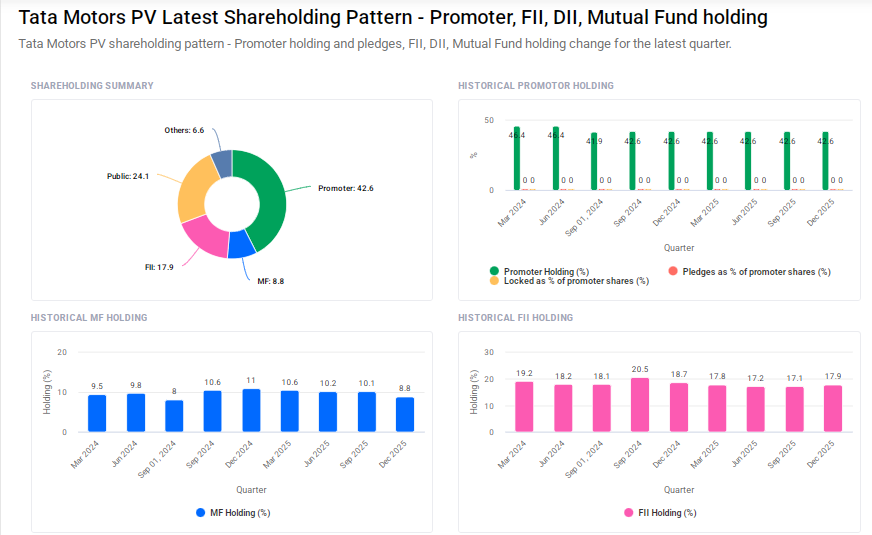
| Promoter | 42.6% |
| FII | 17.9% |
| DII | 15.4% |
| Public | 24.1% |
Income Statement Of Tata Motors
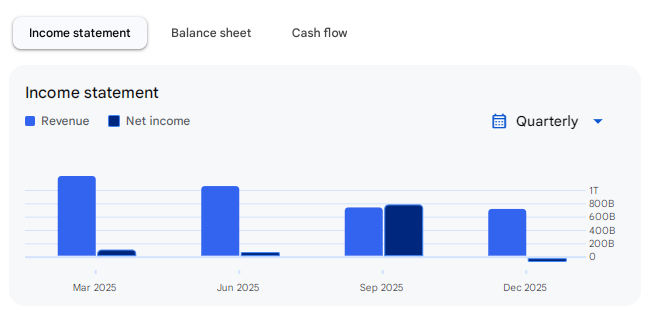
|
All values in INR
|
Mar 2025
|
Jun 2025
|
Sep 2025
|
Dec 2025
|
|---|---|---|---|---|
|
Revenue
|
1.20T
|
1.04T
|
723.49B
|
701.08B
|
|
Cost of goods sold
|
667.89B
|
591.59B
|
403.44B
|
359.82B
|
|
Cost of revenue
|
667.89B
|
591.59B
|
403.44B
|
359.82B
|
|
Research and development expenses
|
22.39B
|
25.16B
|
35.39B
|
32.40B
|
|
Total research and development expenses
|
–
|
–
|
–
|
–
|
|
Selling, general, and admin expenses
|
126.63B
|
124.91B
|
108.31B
|
113.81B
|
|
Operating expense
|
398.75B
|
393.25B
|
364.52B
|
366.87B
|
|
Total operating expenses
|
1.07T
|
984.84B
|
767.96B
|
726.69B
|
|
Operating income
|
128.39B
|
59.23B
|
-44.47B
|
-25.61B
|
|
Other non operating income
|
–
|
–
|
–
|
–
|
|
EBT including unusual items
|
115.04B
|
55.61B
|
-80.70B
|
-47.33B
|
|
EBT excluding unusual items
|
120.51B
|
56.17B
|
-54.56B
|
-31.36B
|
|
Income tax expense
|
29.48B
|
15.58B
|
-17.02B
|
-12.50B
|
|
Effective tax rate
|
25.63%
|
28.02%
|
21.09%
|
26.41%
|
|
Other operating expenses
|
196.78B
|
189.98B
|
172.11B
|
170.97B
|
|
Net income
|
84.70B
|
39.24B
|
761.70B
|
-34.86B
|
|
Net profit margin
|
7.09%
|
3.76%
|
105.28%
|
-4.97%
|
|
Earnings per share
|
24.55
|
10.76
|
-11.91
|
-6.27
|
|
Interest and investment income
|
–
|
–
|
–
|
–
|
|
Interest expense
|
-10.76B
|
-9.38B
|
-6.86B
|
-6.82B
|
|
Net interest expenses
|
-10.76B
|
-9.38B
|
-6.86B
|
-6.82B
|
|
Depreciation and amortization charges
|
52.95B
|
53.20B
|
48.71B
|
49.69B
|
|
EBITDA
|
186.53B
|
87.49B
|
6.49B
|
2.65B
|
|
Gain or loss from assets sale
|
–
|
–
|
–
|
–
|

Hi, I’m Ronak, a news writer covering the latest updates in automobiles, education, smartphones, and trending topics. I focus on delivering simple, clear, and timely news to keep readers informed about what’s happening around the world.